



History of Freemasonry
From medieval stonemasons to modern times
There are several theories about the origins of Freemasonry, ranging from ancient builders to medieval stonemasons. Still to this day, the roots of modern Freemasonry are the subject of intense speculation, but the general consensus among Masonic scholars is that they lie with the medieval stonemasons that built our castles and cathedrals.

Origins
The widely accepted view from many Masonic scholars is that Freemasonry originates from the medieval stonemasons that built many of our castles and cathedrals.

First Recorded Initiation
Elias Ashmole wrote about his initiation in a Lodge in Warrington in 1646, the first recorded evidence of the initiation of an English speculative mason.

Gentlemen Made Masons
From the 1660s, more evidence exists of gentlemen being made Freemasons.

First Grand Lodge
On St John's Day, 24 June 1717, four London Lodges came together at the Goose and Gridiron Tavern in St Paul's Churchyard, declared themselves a Grand Lodge and elected Anthony Sayer as their first Grand Master — the first Grand Lodge in the world.

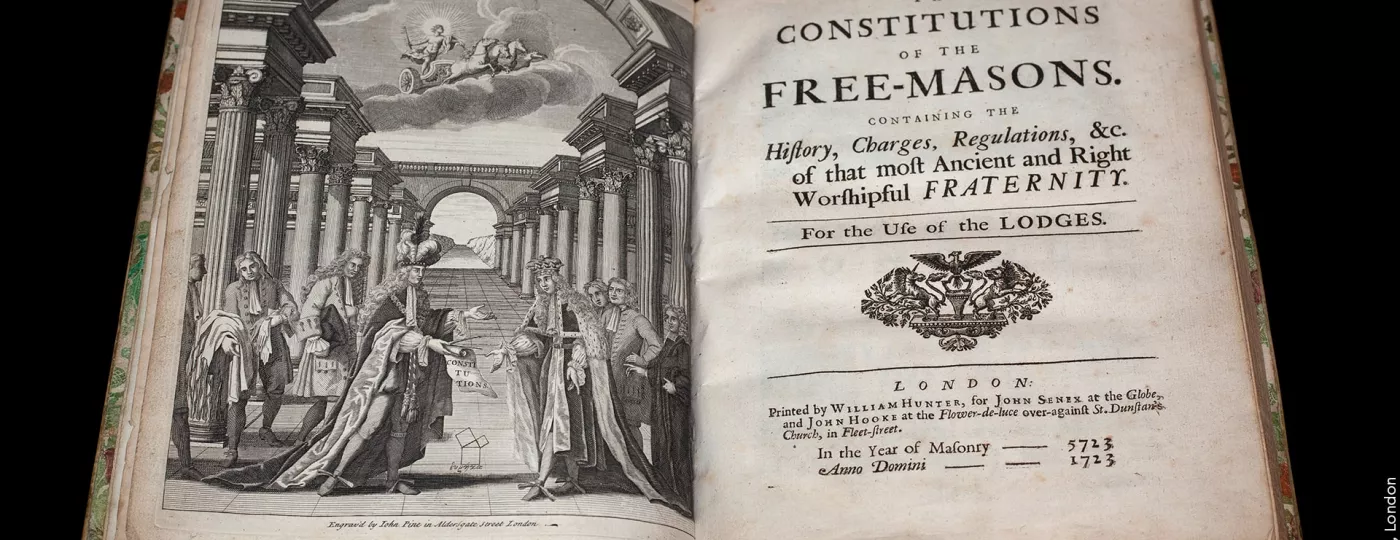
The Constitutions
The new Grand Lodge published its first rulebook — The Constitutions of the Free-Masons — and was meeting quarterly and recording its meetings.

Grand Lodge of Ireland
The Grand Lodge of Ireland was established.

Grand Lodge of Scotland
The Grand Lodge of Scotland was established.

The Antients
A rival Grand Lodge appeared in London. London Scottish and Irish Freemasons formed a rival Grand Lodge, labelling the original Grand Lodge 'Moderns' and calling themselves 'Antients'.

Great Queen Street
English Freemasonry's home has been on Great Queen Street since 1775.

United Grand Lodge of England
After nearly 63 years, the two Grand Lodges in England united on 27 December 1813 to form the United Grand Lodge of England. This union led to a great deal of standardisation of ritual, procedures and regalia.

Expansion
Some 647 Lodges were in existence. The 19th century saw a great expansion of Freemasonry — both at home and abroad.

2,800 Lodges
2,800 Lodges now existed under the jurisdiction of the United Grand Lodge of England.

Freemasons' Hall
United Grand Lodge of England's headquarters Freemasons' Hall — originally called the Masonic Peace Memorial — were built between 1927 and 1933, as a memorial to more than 3,000 members who lost their lives in the First World War.

The World Wars
The two World Wars both had a great effect on English Freemasonry. In the three years after the First World War, more than 350 new Lodges were set up; and in the three years after the Second World War, nearly 600 new Lodges came into being.

250th Anniversary
On 14 June 1967, the 250th anniversary of Grand Lodge was celebrated at the Royal Albert Hall, with the installation of HRH The Duke of Kent as Grand Master.
Weald Lodge Founded
Weald Lodge No. 2707 was consecrated — our own place in this long history.